Nowhere man...
|
 |
Demand Number One: the right to positive portrayal
By
Michael Bronski
Onegin
With Ralph Fiennes, Liv Tylor, Toby Stephens
How to order
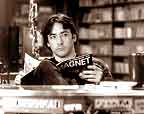
High Fidelity
Directed by Stephen Frears
With John Cusack, Iben Hjejle, Catherine Zeta-Jones, Lili Taylor, Natasha Gregson Wagner
How to order
Gay critics and audiences have long debated how queers should be represented on stage and screen. Fights about "good" vs. "negative" images have raged. One queen's psychotic homosexual who wants to spread AIDS
is another queen's high-strung Byronic hero (The Living
End). While these arguments will last so long as there are two queens left in the world, they miss a more interesting point: why doesn't anyone debate these points
about heterosexuals?
When was the last time you went into a straight bar and heard, "I don't care. I think that
both Meg Ryan and Tom Hanks gave really negative portrayals of heterosexuals in
You've Got Mail. They were cartoons of human beings. I'm personally offended."
No, you've never heard this. But why? Meg Ryan and Tom Hanks portrayed shallow characters who-- bumbling through an inane plot-- make average American heterosexuals look like fools. Where
is "Heterosexuals Against Defamation of Encroached (upon) Straights" (HADES) to defend the rights of straight people to be presented in the best possible light? Two recent movies-- one lowbrow, the other "arty"-- have
hit theater screens and give terribly negative portrayals of heterosexuality:
High Fidelity and
Onegin.
High Fidelity is directed by the usually talented Stephen Frears (noted for, among others,
Prick Up Your Ears, about gay British playwright Joe Orton, who was murdered by his lover (the movie was a
cultural high point in the negative portrayal of queers). Based on a novel by Nick Hornby,
High Fidelity tells the story of Rob Gordon (John Cusack), a sad-sack straight man unlucky in love. The reason soon becomes clear: Rob
may be cute enough, but he's selfish and shallow. The most interesting thing is that he runs a used-record shop and obsessively makes lists of his top five faves: "top five songs to play when you are depressed," "top five songs
to play at a funeral," "top five songs to play when you need something to think about during a boring movie."
Rob's lover Laura (Iben Hjejle) leaves him. Rob tries to figure out what he's done wrong. This takes us through a veritable heterosexual house of horrors. As he recollects one failed relationship after
another-- Charlie (Catherine Zeta-Jones) is an insincere artist type, Sarah (Lili Taylor) is too needy, Carolyn (Natasha Gregson Wagner) is too whatever-- it becomes clear that the problem is Rob himself and his emotional
immaturity. When Rob and Laura finally get back together-- the turning point is when they fuck in her car during her father's funeral-- it's clear that neither has grown much, pointing up that heterosexuality is more an arrested stage
of develo pment than a valid orientation. The only bright lights in the film are Dick and Barry, two geeky clerks in Rob's store who, while apparently heterosexual, seem so queer that they emerge untainted by the
film's negativism toward all things straight.
Now in the art houses things are not much better.
Onegin-- based on the poem "Eugene Onegin" by Alexander Pushkin-- is a long, dreary mediation on heterosexual obsession and the dangers of romantic
love. Eugene Onegin is one of those classic stories of doomed het-romance that achieves a greatness conferred by sheer repetition: it has been the basis for an opera, a ballet, some tone poems, and several earlier films.
This repetition indicates that heterosexuals, apparently self-hating in the extreme, cannot get enough of negative images of their behaviors. The plot is all-too-typical for its genre: Eugene Onegin (Ralph Fiennes) toys with
the affections of the lovely Tatyana (Liv Tylor, she of the trembling lower lip), who loves him in an unrequited way that straights think is dreamy. This leads to misunderstandings, and finally Eugene is challenged to a duel
by Vladimir (Toby Stephens), who wants to be manly and defend Tatyana's honor, but only succeeds in getting killed. Years later, Tatyana has married well-- apparently for money (a frequent failing for many heterosexuals
who would rather have money than good sex), and Eugene falls in love with her only to be rejected. All in all an unpretty picture.
Onegin parades out the usual ugly "truths" with which heterosexuals have always been branded: the inability to love, attraction to wealth and social status in lieu of commitment, tendencies to violence,
and inclinations to depression. This is the sort of movie that could push straight youth to suicide. (Luckily, since Pushkin's poem is considered great literature and was not written in simple English, there is little chance of
students being exposed to it in American schools.)
So the question remains? Why do heterosexuals allow these movies to be distributed without a peep of complaint? Where are the defenders of heterosexuality? Where its champions? Where the voices who
will claim for heterosexuality the same lofty ideals and vision that homosexuality has? One can only presume heterosexuals believe the lies about themselves in these films. Or maybe, just maybe, they admit deep down that
these movies are not lies, but well, the truth.
| Author Profile: Michael Bronski |
|
Michael Bronski is the author of
Culture Clash: The Making of Gay
Sensibility and The Pleasure
Principle: Sex, Backlash, and the
Struggle for Gay Freedom. He writes
frequently on sex, books, movies, and
culture, and lives in Cambridge,
Massachusetts. |
| Email: |
mabronski@aol.com |
You are not logged in.
No comments yet, but
click here to be the first to comment on this
Movie Review!
|