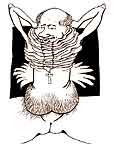
Sex is biology's engine of creativity. It also revs up language. A conversation with A.D. Peterkin, who has compiled a new thesaurus of sexual slang
By
Bill Andriette
The Bald Headed Hermit and the Artichoke
By Allan D. Peterkin
published by Arsenal Pulp Press
How to order
A postcard listing synonyms
for "condom," part of a safe-sex education campaign, got A.D. Peterkin thinking. It got him thinking about
how, when it comes to describing things sexual, there are countless ways to skin the cat. Sexual slang
terms proliferate like rabbits, and Peterkin decided to corral as many as he could into a thesaurus.
The result is The Bald Headed Hermit and the
Artichoke (Arsenal Pulp Press, paper,
$13.95) just published with the help-- imagine!-- of a grant from the Department of Canadian Heritage. Bill Andriette speaks with A.D. Peterkin, a writer and psychiatrist, who lives in Toronto.
BA: I was surprised to read about the late-19th century origins of "dick." I would have guessed the
term was from old Middle English, but you say it derives from Derrick, the name of a notorious London
hangman whose victims' penises would get engorged as they dangled in his noose, and that what was dubbed a
"derrick" eventually got shortened to "dick."
AP: In researching etymologies I found there would be differences of opinion. A lot of people
have different explanations of the origins of the basic sexual slang words, such as "fuck." What amused me was that
a lot of the words were invented by Shakespeare. He was probably the first in the written language to refer
to orgasm as "to come." Then you get variations in spelling, like "cum."
BA: Where did you look for slang and obscure words about sex?
AP: There were numerous sources-- dictionaries, slang thesauruses, web sites. I interviewed people
in specific communities to get up-to-date terminology, since many common slang words are either derogatory
or outdated. So for instance I contacted a fellow who runs a large web site for the SM community and
fetishists, and he helped me nail down a lot of terms.
BA: One of the functions of slang is to define an in-group from an out-group. A lot of the words you
list have purchase only within certain small communities. The more divided off a group of people-- say
sailors living together at sea for months at a time-- the richer and saltier their slang.
AP: There were certainly secret codes for specific communities, but now you see what were
formerly code terms being used quite broadly. I think the media are much more candid about sexuality in general,
and they also are open to embracing specialized slang.
BA: How do you think this new openness affects the creation of new slang?
AP: Part of the reason sexual slang was so rich is that it gave name to what couldn't be said. That
which isn't given open expression finds all kinds of ways of being expressed, in a spirit that ranges from humorous
or poetic to the really quite obscene or derogatory. I still think that a lot of these terms would not be used on TV
or radio, but they might be used in common usage, particularly among young people.
BA: As soon as you create new openness, you also end up building new walls. No matter how
much openness, there are always topics that are unsayable in public, and terms that get their power by referring
to those forbidden areas.
AP: Yes, often the envelope gets pushed and some of the newer terms really take things to the extreme.
BA: Were there any expressions that went beyond what you wanted to publish-- or felt that you
could publish with Canadian government funding?
AP: We really tried not to censor. In the last year there's been quite a controversy because
Merriam Webster and Roget's were lobbied to remove terms for gay people or women that were derogatory. We
decided that the reader was intelligent enough to look at the lists and be careful about usage. Because there have
been really a lot of negative terms about gays and lesbians, we provided references where appropriate terms could
be looked up. I didn't seek to exclude anything, and I may be criticized for that because some of the terms are
quite outrageous. The only exception was anything that was, let's say, particularly illegal. We chose not to have
a section that would either cruelly pathologize pedophilia or make light of it. That was the one section that we
did delete.
BA: That says something about what's unsayable in the West in the late 20th century. It would
be interesting to find underneath that conformity a world of slang that takes apart or ridicules some of the
new orthodoxies.
AP: Yes, I think that's right
BA: Some of these slang terms, like "dick," end up with staying power while others fade away
quickly. Do you think 22nd-century English speakers will know what a "lewinsky" is?
AP: That one I think is a flash in the pan. How many people will know what "to bobbit" somebody
is? These references may not endure.
BA: But it's interesting that something like "dick" has.
AP: You listen to a word like that and it has a very strong sort of male consonant sound. I think some
of the words almost suggests something virile, which is why they endure.
BA: Marginal groups have often been at the forefront of cultural innovation. Did you find that
gay people have disproportionately enriched the sexual lexicon?
AP: Sexual slang has been the domain mostly of heterosexual males, who often demean women
and sexual variation. But over time, various communities have developed their own slang. For instance, the slang
of women was generally about childbirth and menstruation. Especially in the last 25 years, though, you
find women objectifying men and their bodies and making light of female masturbation. Women have pet names
for their breasts that they use commonly. So women have developed a very complex slang, and gays and
lesbians certainly have. Often you see previously derogatory terms-- "fag," "queer"-- reappropriated by the
gay community and used defiantly. The same has happened with the transgendered community, originally subject
to quite derogatory terms and now making some quite playful contributions to the slang lexicon themselves.
But also there's a whole richness of slang that was once coded-- referring to sailors as "seafood," for
instance. There's a list in the book of different types of queens-- tearoom queen, dairy queen, head queen, skin
queen-- with many very playful variations. Certain SM activities have become chic, so that terms are used more
widely than perhaps originally intended. Programs like "Jerry Springer" make a bit of a circus of sex and
sexual variation, but nonetheless new slang terms are being heard by millions.
BA: As a psychiatrist, you must be interested in the different uses of sexual slang. As well as
its derogatory aspect, there's playfulness about a lot of the sexual terms you compiled that has a way of
opening doors to sexual discussion.
AP: There's a beauty in the language just in the sheer variation. This book has over 15,000
synonyms, from Australian, British, Canadian, and American sources. What I discovered is that almost any act you
can possibly think of has been named, almost every inch of the human body has been fetishized or sexualized.
There are people who are turned on by tears, specifically tears in the eyes of the partner, and that activity has
been named.
Something that caught me by surprise is that there were relatively few synonyms for "love"-- that's
one of the shortest lists in the book. But I guess you could always talk about love but you couldn't talk about,
say, breasts or pregnancy, which used to be called "in a family way." There were all these euphemisms to
avoid stating what was obvious to everyone.
I was drawn to some of the very poetic language. Some of the Indian or Tibetan terms for
vagina translate as "enchanted garden" or "great jewel" or "lotus blossom" or "valley of joy." But I also love
the humorous ones. You see all the sorts of literary devices that have been used to invent sexual slang-- Pig
Latin, alliteration, abbreviation, acronyms, metaphors, secret code.
There's a great playfulness when people talk about sexuality, and a sort of wink-wink, nudge-nudge
that I think reflects the energy of sexuality. It can be a dark energy, a playful energy , a very poetic energy, and
the language certainly conveys that.
BA: So is this a golden age of sexual slang, with the mass media's reach and its hunger for novelty?
Or do the media impose linguistic homogeneity that thwarts slang's development?
AP: Well when you get these various movements of sexual chic, everyone starts mimicking
behaviors and then using the language. There is a whole rap sexual lexicon, for instance, with a vast new range
of euphemisms for intercourse. Street kids always come up with new terms. And look at Viagra and its effects
on the vocabulary, with George Bush [editor's note:
Bob Dole actually, but flaccid gray Republicans do
blur together] talking about his "ED," his "erectile dysfunction," which allows us to talk about impotence in a
way that we hadn't. With the Clinton scandal, people in bars in Washington began talking about very playfully
about "inappropriate relationships." To "lewinsky" somebody became a verb. Tinky Winky is a gay icon now. Is it
a golden age? I just think the language will continue to grow and be toyed with. If one of the purposes of
sexual slang is to really push to what can't be said, there may be even more outrageous terms yet to emerge. **
| Author Profile: Bill Andriette |
| Bill Andriette is features editor of
The Guide |
| Email: |
theguide@guidemag.com |
You are not logged in.
No comments yet, but
click here to be the first to comment on this
Magazine Article!
|





 Advertise with us
Subscriptions
Contact us
Site map
Translate
Advertise with us
Subscriptions
Contact us
Site map
Translate