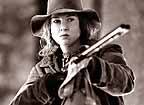
Out of the kitchen-- Zellweger in Cold Mountain
|
 |
...for the supporting gal
By
Michael Bronski
Along with Stonewall and Halloween, the Academy Awards are an annual holiday in Gaydom. For decades queens have gathered in front of their televisions to watch, with baited breath--
no matter how intense the tedium-- the yearly masturbatory PR gambit that the film industry produces for itself. Sure it's fun, and even when not, it has the fascination of a car wreck.
And every year there are debates about the gay favorites-- usually in the Best Actress category. Gay culture's fascination with female stars is well known-- after all, gay men love
Judy, and Bette, and Kate, and Marlene, and Greta. And it's true, these women have entered into the gay cult pantheon. But they are really, in the minds of most movie queens, sort of beside
the point. They are-- in the argot-- divine, and as such, beyond reach. In contrast to these stars-- recognized in the Best Actress category-- are the women who are, well, Supporting
Actresses. And as beloved as the stars are, it's often these lesser lights who are the true devotional saints in gay-male religion.
The women in the Best Supporting category are-- in industry parlance-- "character" actresses. They have-- character. They are often odd, quirky, non-romantic, and sometimes
weird. They often play the lead actress's "best friend," and on a regular basis have no romantic interests for themselves. They are the "odd girl out," the lonely or misunderstood wife, the
pariah girlfriend, or even the female pariah misunderstood by society. Is it any wonder that these women capture the imagination of gay audiences? This is not the "star" category but the "fag
hag" category-- with nothing derogatory intended in the term.
Friends of friends of Dorothy
Just look at this year: Shohreh Aghdashloo was nominated for
House of Sand and Fog, Patricia Clarkson for
Pieces of April, Marcia Gay Harden for Mystic
River, Holly Hunter for Thirteen, and Renée Zellweger (who won) for
Cold Mountain. All these actresses completely fit the bill for fag hag-dom. Aghdashloo is defined by her emotional intensity, not her romantic
appeal. Clarkson (who has quickly become the Agnes Moorehead of our times-- a great compliment to any performer) is defined by her quirkiness and her emotional range. Hardin and Hunter
have both always been defined by their singular ability to convey complicated emotions in a harsh, forthright manner. And Zellweger has the open and likeable girl-next-door persona of a
Betty Hutton or a Judy Holliday-- but could never be a romantic lead.
Look over the past nominees for Best Supporting Actress and there's a clear pattern: they've all challenged how Hollywood and America have thought about, and portrayed, what it
is to be a woman.
In 1950-- as good as date to begin as any-- the pattern seems to be set. Here we have Hope Emerson nominated for playing the lesbian prison matron in
Caged; Celeste Holm, for her performance as Bette Davis's best friend in
All about Eve; Nancy Olson, as William Holden's understanding girlfriend in
Sunset Boulevard; Thelma Ritter, as Bette Davis's wisecracking
maid in All about Eve; and Josephine Hull (who won) as Jimmy Stewart's ditzy aunt in
Harvey.
Hull was great in Harvey, but most queens would insist that the award should have gone to Ritter for her knockout performance in
Eve. All these actresses are great, and their films
gave them roles that had an enormous amount with which to work.
Modes of iconoclasm
Ritter is a case in point-- beginning in 1950 she was nominated six times in just over a decade in the Best Supporting category, never winning once. Ritter defined her roles-- she
was the wisecracker with a heart of gold, the older woman who knew more than she was willing to let on, and often the only character who spoke the truth about what was happening. She
was charming, funny, pungent, and always viscerally immediate in her performance. This is what the Best-Supporting category calls for.
Perusing the nominated actresses we can see that the types may vary-- ditzy older woman (Margaret Rutherford gets nominated for this), cold-bitch type (Angela Lansbury is
an expert), daffy comedienne (the Una Merkle role), gender deviant (Mercedes McCambridge)-- but the underlying impulse is the same: these are women who exist outside prescribed roles
and who defy convention. Sometimes there are actresses who lurk on the edges of these categories-- Hope Lange in
Peyton Place or Susan Kohner in Imitation of
Life, both of whom give sensational performances-- but they are usually screen debuts who are simply waiting (as these actresses did) for far better, and odder, roles later in their careers.
The Academy Awards have, once again, come and gone, and they were as queer as ever in their over-the-top sensibility. But once more-- as in the past-- the gayest moments were
when the Supporting Actress were front and center.
| Author Profile: Michael Bronski |
|
Michael Bronski is the author of
Culture Clash: The Making of Gay
Sensibility and The Pleasure
Principle: Sex, Backlash, and the
Struggle for Gay Freedom. He writes
frequently on sex, books, movies, and
culture, and lives in Cambridge,
Massachusetts. |
| Email: |
mabronski@aol.com |
You are not logged in.
No comments yet, but
click here to be the first to comment on this
Movie Review!
|