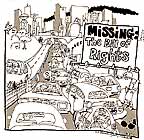
New law uses hysteria over queer sex crime to gut US Constitution
By
Jim D'Entremont
George W. Bush, fresh from his putative triumph in Iraq, beamed and twinkled in the spring sunshine as he signed the PROTECT Act of 2003 into law on April 30.
Among the spectators flanking him in the White House Rose Garden, where the staged-for-television bill-signing rite took place, were tabloid heroine Elizabeth Smart, the
15-year-old poster girl for child abduction; teenage kidnap celebrities Jacqueline Maris and Tamara Brooks; officials of the National Center for Missing and Exploited Children (NCMEC); and the
parents of Amber Hagerman, an Arlington, Texas 9-year-old who was snatched from her bicycle and murdered in 1996. As a source of instant footage for the 2004 Presidential campaign, the
event has thus far only been topped by Bush's victory-in-Baghdad speech aboard the aircraft
carrier Abraham Lincoln on the following day.
PROTECT stands for "Prosecutorial Remedies and Other Tools to End the Exploitation of Children Today." The ungainly phrase behind the acronym echoes that of the
legislative package's trend-setting sibling, the assault on the Bill of Rights called the "Uniting and Strengthening America by Providing Appropriate Tools Required to Intercept and Obstruct
Terrorism" (USA PATRIOT) Act of 2001.
In its signature provision, the PROTECT Act strengthens the "AMBER Alert" system already in place in at least 38 states. Borrowing Amber Hagerman's first name to create another
Age-of-Bush acronym, the AMBER (America's Missing: Broadcast Emergency Response) plan is a cooperative effort between law enforcement officials and the Emergency Alert System (EAS)
to produce radio announcements, television bulletins, and electronic road signs describing missing children and their suspected abductors. Its goal is a national communications network
that can spring into action when a child is kidnapped. Even though, in the current climate of paranoid child protection, its potential for fomenting vigilantism sparks concern, the
notification system is not inherently a bad idea.
But the final version of the PROTECT Act is additionally clogged with vote-getting, crowd-pleasing, freedom-abrogating legislative mulch. Its provisions make incursions into an array
of civil rights protections, limit judicial discretionary options, increase already draconian penalties for sexual offenses, and enhance the prosecutorial power of the state.
The PROTECT Act marched through Congress on April 10. No hearings were held to examine its more troublesome features. The Senate gave the bill unanimous approval; the
House voted 400-25 in its favor. As the 51-page mass of child-safety laws--popularly known as the "AMBER Alert Bill"--went to the President's desk, few news reports covered the breadth
and depth of what it contained. A New York
Times editorial did at least note that "Under the guise of protecting children, Congress has badly undermined fairness and judicial independence."
Before the final passage of the bill, and then while its House and Senate versions were being reconciled in conference committee, objections to its contents came from a handful
of Congressmen, notably Bobby Scott (D.-Virginia) and William Delahunt (D.-Massachusetts). William Rehnquist, the conservative Chief Justice of the Supreme Court, weighed in with
objections alongside the National Association of Criminal Defense Lawyers and the American Civil Liberties Union.
In a letter of protest delivered to the House and Senate 48 hours before the final vote, ACLU legislative director Laura Murphy warned that while improving the AMBER Alert
system might have its merits, the effort "has become littered with many provisions and proposed amendments that are ill-advised and constitutionally questionable." Nearly all of these
provisions and amendments remained in the PROTECT Act package when it was signed into law.
S. 151, the original Senate version of the PROTECT bill, was initiated by Orrin Hatch (R.-Utah), aided by an across-the-aisle band of supporters. Senator Patrick Leahy of Vermont,
a recently-minted Democrat who returned to his Republican roots for this occasion, added language giving quasi-governmental status to the National Center for Missing and Exploited
Children, giving the organization a privileged relationship with the Secret Service, and doubling its federal funding to $20 million per year.
In collaboration with Hatch, Leahy inserted "virtual child pornography" provisions that seek to restore portions of the 1996 Child Pornography Prevention Act (CPPA) struck down
by the Supreme Court in Ashcroft v. Free Speech
Coalition (2002). This new version of the CPPA bans any computer-generated or digitally enhanced image that "is, or is indistinguishable
from, that of a minor engaging in sexually explicit conduct." The new law criminalizes both possession and production of such material.
At the last minute, Senator Joe Biden (D.-Delaware) slipped in a new version of his hitherto unsuccessful "Rave Act," branding venues for raves and concerts as hotbeds of illegal
drug use, and expanding the Controlled Substance Act to enable law enforcement officials to prosecute the owners and managers of clubs whose patrons are caught using drugs like Ecstasy.
In the House of Representatives, where the AMBER Alert juggernaut was more neatly known as the Child Abduction Prevention Act (CAPA), its principal sponsor was Congressman
F. James Sensenbrenner (R.-Wisconsin), Chairman of the House Judiciary Committee. Sensenbrenner took advantage of CAPA to recycle as amendments several failed bills pertaining
to criminal penalties and surveillance.
Judges replaced by automatons
One of the most insidious ingredients was whipped into the mix by Representative Tom Feeney (R.-Florida) at the request of Attorney General John Ashcroft and the Department
of Justice. The Feeney Amendment, a slap at the US Sentencing Commission, requires federal judges to avoid "downward departures" from the minimum mandatory sentences
(increased sharply by the PROTECT Act) now assigned to a variety of sex offenses. It imposes burdensome reporting requirements whenever judges opt for leniency because of mitigating
circumstances--no matter what the crime--and mandates DOJ scrutiny of judges who give lighter sentences.
As Chief Justice Rehnquist pointed out in a letter to Congress, the Feeney Amendment does "serious harm to the basic structure of the sentencing guideline system" and
"seriously impair[s] the ability of courts to impose just and responsible sentences." It will also swell the prison population of a nation that already incarcerates a higher percentage of its populace
than any other nation. The Washington Post called the Feeney approach to sentencing "mechanical justice, inflexible and unresponsive to human variation."
The provisions that address the alleged porn hell of the Internet include a section making it a federal offense to lure adults or children into accessing obscene websites by
using misleading domain names like "Barbie." The vagueness of the term "misleading"--and the dubiousness of criminalizing attributed intent--seem not to have bothered members of
Congress. The PROTECT Act also facilitates prosecution of alleged sex tour operators and people suspected of traveling overseas for sex with minors, creating the thoughtcrime of "traveling
with intent to engage in illicit sexual conduct."
In other measures, the PROTECT Act expands wiretap standards already relaxed under the USA PATRIOT Act; prohibits taking a child outside the US to circumvent custody
battles; requires convicted child pornographers to add their names to the National Sex Offender Registry; requires states to publish sex offender registries on the Internet; eliminates pre-trial
release for accused sex offenders; introduces a "Two Strikes and You're Out" rule making life imprisonment mandatory when someone commits a second sexual offense involving a minor;
eliminates the statute of limitations for sex crimes involving minors; and broadens the availability of the death penalty.
Child protectionists hailed the AMBER Alert Bill as a breakthrough in comprehensive child-safety legislation. "This bill is a huge first step in the right direction," proclaimed
NCMEC president Ernie Allen.
Civil libertarians might point out that a plethora of child-safety laws already existed--and wonder just what Allen thinks the next step should entail. The name
AMBER Alert echoes Attorney General John Ashcroft's color-coded grades of vigilance in response to real or imagined threats of terrorism. In the age of the Homeland Security State, the US
government increasingly conflates purported child abusers with terrorists, fusing the two great bugaboos invoked whenever the US government expects its citizens to forfeit civil liberties gladly.
Bullied into supporting a reckless war, floundering through efforts to shore up a flagging economy, Congress appears to have thought: when in doubt, save the children. In doing so,
the legislative body embraces the agenda of the Bush Administration, which--even as it claims to be helping democracy blossom abroad--is planting the seeds of totalitarianism in American soil.
You are not logged in.
No comments yet, but
click here to be the first to comment on this
News Slant!
|





 Advertise with us
Subscriptions
Contact us
Site map
Translate
Advertise with us
Subscriptions
Contact us
Site map
Translate