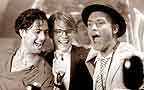
He (c) is a charmer
|
 |
Mr. Ripley's movie makeover
By
Michael Bronski
Talented Mr. Ripley, The
Directed by Anthony Minghella; based on the novel by Patricia Highamith; with Matt Damon, Jude Law, Gwenyth Paltrow.
How to order
What a curious book The Talented Mr.
Ripley must have seemed when Patricia Highsmith published it in 1955. World War II had been over for a decade, the US
was in the middle of its biggest economic boom since the 1920s, and the country was about to pitch forth into anti-Communist hysteria. On the surface America was pretending
that Leave It to Beaver and Father Knows
Best were everyday life, but outside of TV-land things were quite different. African-Americans were pressing ever more boldly for
civil rights. The Beats captured the public imagination by mocking work and the nuclear family. Betty Friedan's
The Feminine Mystique was being written. Rock and roll was seen
by many adults as wrecking havoc with traditional social, racial, moral, and musical norms. The tabloid and mainstream press were obsessed with the threat of the
juvenile delinquent. And to make things worse, homosexuals were becoming more public. Nothing was what it seemed, and who knew what unspoken terror lay in waiting around
the corner.
Enter Tom Ripley, a petty thief and con artist who stumbles into a grift of a lifetime. Dicky Greenleaf, a casual friend of a friend, is a ne'er-do-well rich boy living in
Italy, halfheartedly pursuing a career as an artist. His father, a shipping magnate, finances Ripley to visit his son and convince him to return home to the family business. Ripley goes
to Italy, becomes obsessed with Dickey-- a mixture of wanting him sexually and wanting to
be him-- and ends up murdering his quarry. He then takes on Dicky's identity (as well
as his bank accounts) and ends up killing one of Dicky's friends when he is about to be found out. Successfully juggling identities, he manages to blame the second murder
on Dicky, fake the dead-man's suicide, forge a will, and leave everything to himself.
What Highsmith brought to this character was cool, detached elegance. "Ripley's not that bad," she once told an interviewer. "He only kills when he has to." What she
also brought was the notion-- fundamental to post-war modernism-- that
Tom Ripley is no more guilty than anyone else in the world. This is the obverse of the truth
she hammered home in her first novel, the 1949 Strangers on a
Train, in which everyone was guilty of something. In
The Talented Mr. Ripley, guilt has become so
common, so equitably shared, as to be negligible.
The Ripley of Highsmith's novel is the embodiment of every 1950s fear: a socially-climbing, sociopathic homosexual who looks like a nice young man. His
own identity is so shaky and unbounded that he has no trouble taking on other people's. He does dead-accurate impersonations. He is never who or what he seems to be.
And he is the hero of Highsmith novel. If Tom Ripley is evil-- and Highsmith would admit to as much-- he does not represent what Hannah Arendt called "the banality of evil,"
but rather its allure and charm. If anything, Highsmith considers the boring, humdrum conventionality of the 1950s the true "banality of evil," and Ripley is her answer and
ultimate threat. In the novel-- and Anthony Minghella's new film version-- we, as readers and viewers, root for
Tom Ripley to get away with his crimes. But there is a telling
difference between Highsmith's unsettlingly straightforward and amoral novel and Minghella's sentimentalized and sanitized film version that features Matt Damon as the
talented Mr. R.
Minghella's handling is capable
enough-- The Talented Mr. Ripley is as neat a catch-your-breath thriller as could be imagined. But as compelling as the film is,
it diverges sharply from its original source. The director softens Tom Ripley, makes him less of a psychopath and more of a confused gay man who is at a
social disadvantage in a world peopled with folk who are not his equals and who are mean to him. Matt Damon's Ripley is more guilty of looking for love in all the
wrong places and being rejected than of cold-blooded murder. In the film, Ripley kills Dickey in a fit of anger after being humiliated and rejected; in Highsmith's
version, Ripley simply sees a chance and makes his move. The on-screen Ripley is even capable of love-- something that Highsmith could never have countenanced.
Minghella has also coarsened Dicky Greenleaf-- in an attempt to make Tom Ripley more sympathetic. In Highsmith's novel Tom Ripley hates Marge Sherwood,
Dickey's sometimes girlfriend with a misogynistic fervor, but here Minghella creates a close bond between the two, and the effect is that, once again, Tom Ripley is not that bad a fellow.
It probably would have been a hard sell for Minghella to bring Highsmith's
Talented Mr. Ripley to the screen. There is a
big difference between confused gay con-men and unfeeling sociopaths. Movie audiences may have rejected a Ripley-- and a Matt
Damon-- who lacked a certain basic sympathy. He may also have worried about presenting a gay character who had
no redeeming qualities aside from cool charm and cold calculation. If Minghella had remained true to Highsmith, this
Talented Mr. Ripley would have been quite a different film: nastier, more archly witty, unsettling. But as it is, we have a Tom Ripley-- and a sort of homosexual hero-- for the
new millennium: a killer kinder, gentler, and far less
threatening.
| Author Profile: Michael Bronski |
|
Michael Bronski is the author of
Culture Clash: The Making of Gay
Sensibility and The Pleasure
Principle: Sex, Backlash, and the
Struggle for Gay Freedom. He writes
frequently on sex, books, movies, and
culture, and lives in Cambridge,
Massachusetts. |
| Email: |
mabronski@aol.com |
You are not logged in.
No comments yet, but
click here to be the first to comment on this
Movie Review!
|