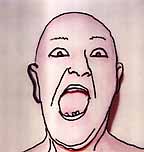
Self portrait (1987)
|
 |
The root of beauty lies in eros, argues painter Ted Titolo. So is all art about sex?
By
Bill Andriette
"I am not pure anything," says Ted
Titolo, who at age 73 has under his
belt more than a half-century of
drawing, painting, photography, and
collage, with some sculpture and video
tossed in
for measure. Variably droll, haunting,
and mordant, Titolo's creations are
stylistically diverse-- his works over
the years seem like they could be
those not just of different artists,
but different eras
and cultures. In the Titoloean oeuvre,
realist portrayals that could be
declarative sentences stand
side-by-side works abstract and
encrypted enough to be utterances of
Herr Rorschach or the
Delphic oracle.
But there's usually a few
drops of lubricating playfulness in
the mix. A drawing headlined "God"
presents the Judeo-Christian desert
deity as Bitch Queen from Hell,
dishing out the
Ten Commandments afresh. Commandment
Six: "Fuck only to make copies of you
(man on top), otherwise, no sucking,
lapping, tonguing, rimming, poop
fucking, sleep loads. Don't even think
of touching it down there. And no tit
pinching." In "American Kouros," a
chapbook of text and naively-rendered
color drawings, Titolo casts a quietly
outraged eye on American sexual
puritanism,
like the gaze William Blake cast over
England's early industrial wastes.
Elsewhere, Titolo's work is just
sheerly, exuberantly Out There-- as
with a series of colorfully line-drawn
fairies
dancing superimposed over photos of
grazing cows. Underlying it all-- if
any one thing is-- there's a
distinctive queer sensibility.
Titolo studied art and
psychology at Bucknell in the late
1940s, and then-- deemed too mad and
too homo-- was booted from the army in
time to miss the Korean war. He
travelled around
the country acting in a children's
theater production and driving the
scenery truck before settling in New
York. Titolo spent much of the 50s
pushing paper in an office on Wall
Street. Though he'd
sneak off to museums at lunch hour,
life as Organization Man was not
Titolo's cup of tea. He'd already been
hovering around New York's art scene--
then in one of its most electric
periods-- so he
dropped out, tuned in, and turned on.
He found inspiration in the work of
Jack Smith, filmmaker and performance
artist whom Titolo dubs "the father of
the anarchistic homo-art 60s." A role
model for
Andy Warhol, Smith was a meticulous
craftsman and flamboyant provocateur
who declared that the most crucial
part of a painting was its title.
A touch of Smith's influence
can be seen in a 1981 photograph of
Titolo painting his own shit with
primary colors-- a photo that redeems
itself for more than shock-value with
the title
"The Birth of Art." (The squeamish
will be relieved to know that the
"shit" is really Crisco and crushed
Oreos-- "No one could manage that kind
of control," he contends.)
Titolo came into his artistic
own in the late 60s when he says he
gave up the hope and desire for career
success. Galleries pressured artists
to find some catchy schtick--
dribbling oils on
canvas, painting celebrities or dogs--
and to stick with it, the better to
insure predictable, salable product.
He and his lover Ben Gillespie lived
the Bohmenian life hand-to-mouth in a
Soho loft-- at a
time when that was not a contradiction
in terms.
But more than just creating to
please only himself, Titolo has
dallied with Buddhist and Taoist
notions of the "death of the artist":
of not even working for oneself, but--
as in
meditation-- shutting down the
apparatus of self-identity, and
engaging experience without questions.
Maybe the meaning of the work that
results is obvious, he says, maybe it
becomes clear later, or
maybe-- like those sprites and cows--
it stays obscure.
Titolo quotes Henry Miller:
"Art is a healing process, as
Nietzsche pointed out. But mainly for
those who practice it. A man... [makes
images]... in order to know himself,
and thus get rid
of self eventually. That is the divine
purpose of art."
Some Buddhists aspire to
Nirvanic nonexistence over life and
the body. Even Buddhism, however, does
not counsel thoughtlessly throwing the
body away, but rather makes it a zone
of
spiritual practice, testing, and
discipline-- the wall against which
you push off onto a higher plane.
Though Titolo hasn't signed on to the
Buddhist program, this idea for using
the body motivates some
of his work. For a self-portrait
"Myself as Chairman of the Board," he
deliberately fatted himself up,
luxuriating in obesity. As his
waistline grew, Titolo says he was
grateful for his lover
Ben's understanding. One of Titolo's
recurring motifs is the contrast
between the fat man and the boy-- the
former the icon of selfish, voluptuous
indulgence, with its onion-layers of
ego; and the
latter signaling spare, clear, direct
awareness.
Ben died of AIDS in 1988 and
gentrification chased Titolo from New
York. He lives now as close to
Manhattan as he can afford-- in a
housing project striped with catwalks
that seem
inspired by Attica or San Quentin.
Hometown is a Connecticut city that--
with its six-lane roads and glass-box
corporate headquarters-- mixes the
worst of New England snobbishness with
freeway-ridden Los Angeles. Walking a
few blocks from his apartment one day
last winter, Titolo was struck by a
car and tossed flat onto the pavement,
his shoulder smashed. An insurance
settlement from
his injuries may give him the
wherewithal to buy a computer and
explore a new world of graphic
manipulation. But maybe there's no
pressing need-- with just Polaroid
shots of his TV screen,
Titolo has created haunted, dusky,
Vermeer-like stills from 70s porn
loops.
Especially today, getting old
often means losing the matrix of
colleagues, friends, and lovers that
nurtured one's life and work. But
getting old-- if you can catch this
particular wave-- can
also dampen inhibitions and free one
to follow one's fancy. As with
soldiers at war, when death looms just
around the bend, what's to lose? The
roots of beauty lie in eros, Titolo
cites Plato
approvingly. Carried along by the
fascination he finds in his subject,
Titolo keeps working, like a medieval
monk in his cell illuminating
manuscripts. Drawings, paintings, and
photos are still flowing, and
he's 400 pages into writing a novel of
sex and ideas loosely inspired by pulp
romance.
Titolo's work has caught the
eye of the New York's Leslie-Lohman
Gay Art Foundation, which has put the
whole of "American Kouros" on its web
site (www.leslie-lohman.org). But
Titolo prickles at the category "gay
art"-- "The gayest painting around is
Michaelangelo's 'Last Judgment'-- no
straight man could summon that
passion," he insists. In a drawing
Titolo made of a
packed Manhattan parking lot, the cars
seem aggressively nose-to-butt, like
hound dogs in heat. Titolo's "Gay
Art"-- in which a pink, campy,
hyper-hung he-man hovers over a
bucolic mountain glen--
is Titolo's tongue-in-cheek reply to
those who want art to be chained,
branded, and trademarked to a sexual
identity.
Titolo is happy not to
expatiate about his work, letting it
speak for itself. But he offers a few
interpretive epigrams. "There's an
ancient tradition of those who see
beyond the material. Blake
was such a giant, and Walt Whitman, a
more recent prophet, said: 'No one
will get at my verses who insists upon
viewing them as literary performance,
or attempt at such performance, or at
aiming mainly toward art or
aestheticism.'"
"If you substitute 'images'
for 'verses,' and 'graphic' for
'literary,'" Titolo goes on, "you will
pretty much understand how I view
things. By no means am I attempting to
place myself in
their company; but it is vision which
instructs that gives me the greatest
pleasure. Creating images is the
practice of meditative magic, and it's
in the making that true religion
occurs,
spiritual-material conjunction. What's
left on the paper is just the residue.
Later, outside the church, it's all
about comparing fashions."
| Author Profile: Bill Andriette |
| Bill Andriette is features editor of
The Guide |
| Email: |
theguide@guidemag.com |
You are not logged in.
No comments yet, but
click here to be the first to comment on this
Magazine Article!
|