Not extra crispy
|
 |
When its always masturbation-- as in a hustler's new memoir
By
Michael Bronski
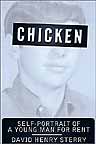
Chicken: Self-portrait of a Young Man for Rent
by David Henry Sterry
Harper
Collins
How to order
Pity the poor hustler-- all work and no
plays usually makes for a dull boy
and more often than not, a dull read.
It used to be, at least in the 1950s
and early 1960s, that whore
memoirs
were usually celebratory. Polly
Adler's A House is Not a
Home and Kenneth Marlow's
Mr. Madam glorified the
American prostitute even as they
pretended that the "life"
was all so
(well, moderately) horrible. Maybe it
is because in the ostensibly dull
1950s being a whore and a hustler
was, well, sort of like being a movie
star: it may have been degrading
work, but at
least it was more interesting than
being a regular person. In a visceral
way, it was an embodiment of the
Horatio Alger view of the American
Dream-- poor boy/girl makes good by
pulling
him/herself up by the boot/bra straps.
Prostitution-- and especially being a
Madam (Mr. or Ms.)-- was an only
slightly disreputable form of
capitalism. Now in these days of
Enron-- where
every capitalist is prone to take the
Fifth-- those involved in
flesh-peddling take a dimmer view of
their activities and lives.
Two years ago, Rick Whitaker's
Assuming the
Position gained some notice for
its dour view of sex, drugs, and
alcohol in the life of its author.
Assuming a literary pose-- along with
a
variety of sexual positions-- Whitaker
regaled us not only with tales of his
tail, but dressed them up with
references to the likes of Leonard
Woolf, Walt Whitman, Kierkegaard,
Andrew Marvell,
and Ludwig Wittgenstein. Whitaker's
life may have been low-down, but his
cultural tastes were high-tone.
Praised by some for its honesty,
Assuming the Position read
more like a exercise
in slumming. After all, Whitaker is a
bright educated boy "with
potential," but we are told again
and again that all of his clients are
more pathetic than he.
The newest entry into the boy
hustler genre is mostly heterosexual.
At first glance
Chicken: Self-portrait of a
Young Man for
Rent has a cheap, sort of
likable quality to it
that makes it closer to Mr.
Madam than to the pity-poor-me
tone of television movies. It is more
"Jerry Springer" than
"Oprah," and its 1970s
setting brings to mind the more
endearing
and enticing moments of Boogie
Nights (only without the charms
of Mark Wahlberg). Perched on the
edge of not-quite-believable-- Sterry
flees his dysfunctional family after
his mother
turns dyke with her best friend and
his mean-spirited father just gets
meaner and attends a Catholic
college in LA that has no dorms so
he ends up on the street-- the book
begins with an
Andy Warholesque flavor (remember
Flesh and
Trash?) but soon
degenerates into a silly,
self-indulgent plea for sympathy and
understanding.
One of the problems with
Chicken is that Sterry is at
stylistic war with himself. Never
resisting a chance to fall into a silly
speed-rap Ken Kesey-type banter--
Lord preserve us from
run-on sentences punctuated by one
word ejaculations-- he simply
becomes loud without casting much
illumination, prattling on and on
without much direction.
There are some stunning
moments of surrealism, such as an
SM costume party that resembles the
silliness of the orgy in
Eyes Wide Shut. But for the
most part, this is a dreary
recitation of a dreary job and life.
Part of the problem is that Sterry
does not have a lot of empathy with
his clients. (One wonders how good
a lay he actually was.) All his tricks
are presented as pathetic or silly or
tedious in what eventually feels like a
constant attempt to make himself
look better. And it's not as though he
doesn't have some good material
here. In one chapter, he's hired by a
middle-aged woman who wants him
to make love to her dressed as her
dead teenage son: now
that is a story. But once again,
Sterry is more interested in his own
pain and confusion than in anyone
else.
This lack of empathy is bolstered
by Sterry's structuring of the narrative
so that his sexual adventures are
intercut with pertinent memories
from his childhood. This sort of
rudimentary technique-- perhaps
suggested by an editor at the end of
his or her rope-- might work if it were
handled correctly. But here it's not.
The grieving mom is juxtaposed with
a Little League
game; the SM orgy is contrasted with
the pet dog birthing a litter-- it's all a
little too obvious and a little too
uninteresting.
Worst of all is Sterry's startling
aversion to homosex. Time and
again he's faced with the possibility
or the reality of sex with men, and
each time it's a physical or emotional
nightmare. Obviously Sterry shouldn't
have sex with men if he doesn't want
to-- although many for-pay boys do
consider it part of the job. But his
revulsion goes unexamined and
unexplained.
(Of course, if we are going to have
gay sex juxtaposed with his
disastrous first time at dance class,
or with finger-painting in
kindergarten, maybe we're better off
without explanations.)
In the end, Chicken feels
homophobic not only because this
memoirist can't imagine having gay
sex, but because he can't even
imagine talking about it. This
profound refusal to enter
into a broader world of sexuality
supplies the backbone of hypocritical
morality to Sterry's memoir. For
Sterry, sex-for-pay is bad not
because it's wrong, but because, in
addition yourself,
it's actually about other people.
| Author Profile: Michael Bronski |

|
Michael Bronski is the author of
Culture Clash: The Making of Gay
Sensibility and The Pleasure
Principle: Sex, Backlash, and the
Struggle for Gay Freedom. He writes
frequently on sex, books, movies, and
culture, and lives in Cambridge,
Massachusetts. |
| Email: |
mabronski@aol.com |
You are not logged in.
No comments yet, but
click here to be the first to comment on this
Book Review!
|