|
 |
Golden oldie returns to print
By
Michael Bronski
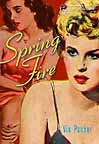
Spring Fire
by Vin Packer, a.k.a. Marijane Meaker
Cleis Press
How to order
It's a treat to have Vin Packer's Spring
Fire back in print after its original publication more then 50 years ago. Generally conceded to be the first "lesbian pulp,"
Spring Fire was written by Marijane Meaker under the very butch-- and gender-neutral-- pen-name Vin Packer. It was a paperback original for Fawcett Publications' Gold Medal Book imprint in February 1952.
Sales expectations were low-- even factoring in a potential straight-male readership. Who'd actually buy a lesbian romance set in a college sorority? The first printing sold 1,463,917 copies.
The new Cleis edition features an introduction by Packer giving some of the background of the story, as well as a lovely cover that's a collage of the original Gold Medal cover art, as
well as the original cover copy: "A story once told in whispers. Now frankly, honestly written." Cleis has also reissued the Ann Bannon
novels-- I Am a Woman, Odd Girl Out, Beebo
Brinker-- and Packer's Spring Fire is a welcomed edition to this reissue list. As famous as these books are in queer publishing's annals, they've been (especially
Spring Fire) essentially unavailable to contemporary readers until now.
A canon bursts out
Spring Fire marked the beginning of several momentous shifts in American letters. It was the beginning of the "lesbian pulp" phenomenon in paperback originals, a craze that
spawned hundreds of titles. While most were written by men for a heterosexual male audience, there were also dozens written by lesbians-- the likes of Ann Bannon, Paula Christian, Valerie
Taylor-- writers who became the foundation of contemporary American lesbian lit. It was also the beginning of the career of Marijane Meeker, who would go on to write 22 more "Vin Packer"
novels (mostly psychological thrillers) as well as-- under the name of M.E. Kerr-- a series of successful young-adult novels, often with themes of edginess and daring (homosexuality
included) surpassing Judy Blume's.
Packer is known as a pulp writer-- and, well, she wrote pulp novels, so that makes sense. But reducing her writing to that label unnecessarily belittles it. Vin Packer is a terrific
novelist-- one of the best storytellers of the 1950s. Her sense of plot and pace is finely-tuned. She sketches characters deftly, with empathy and intuition. And she knows what makes a story
work. If Packer had published these 22 novels in hardcover with more "reputable" houses she, and they, would have a far different reputation now.
Most of the novels that came after Spring
Fire were written quickly, often to capitalize on a cultural or newsworthy event.
The Thrill Kids-- "Kids on the prowl for girls-- for thrills--
for kicks-- for murder" screamed the cover, aside art of a leggy blonde and two overripe teenage boys with switchblade-- capitalized on the juvenile delinquency hysteria at the time. The
1956 Dark Don't Catch Me-- "The murder was easy-- the kid died quickly-- but it was the town that wore the shroud"-- was a response to the brutal murder of black teenager Emmet Till
in Mississippi. In 1962 Packer penned The Girl on the Best Seller
List, a not-veiled-at-all story based on Grace Metalious, author of
Peyton Place. The cover art was parody of the famous
photo of Metalious in jeans and a flannel shirt at her typewriter, and the cover copy read: "The book had laid bare the secrets of an entire town. Now the town would take revenge on the
woman who wrote it." And there are 19 other novels with titles like
Come Destroy Me, Whisper His Sin, The Damnation of Adam
Blessing, and Three Day Terror.
Like Spring Fire these books were written as paperback originals to be sold in bus stations, newspaper stands, and candy stores. But unlike the mass of other such books, Packer's
were not just extraordinarily well-written, but incisive critiques of 1950s culture.
The Thrill Kids is an exploitative novel of juvenile delinquency, but it's told from the viewpoint of the kids. Packer doesn't avoid sensationalism, but still the novel gets behind
the headlines and explores, in an understanding way, why delinquency happens. While the cover of
Dark Don't Catch Me can be read as racist-- a leggy white woman is being looked over by
two black youths-- the novel itself is a searing indictment of Southern racism and its attendant evils. Even the more lightweight
The Girl on the Best Seller List-- clearly this is Packer having
fun not so much at the expense of Grace Metalious but at the media circus around the publication of
Peyton Place-- has razor- sharp commentaries on the hypocrisies and prejudices of
small-town American life.
The collected work of Vin Packer-- only
Spring Fire is available today-- is a vibrant record of the 1950s from an outsider who was writing on the inside. Aside from being great
reads-- these smart and pungent political works can still make us think and react today. Let's hope the rest of her novels follow
Spring Fever back into print.
| Author Profile: Michael Bronski |

|
Michael Bronski is the author of
Culture Clash: The Making of Gay
Sensibility and The Pleasure
Principle: Sex, Backlash, and the
Struggle for Gay Freedom. He writes
frequently on sex, books, movies, and
culture, and lives in Cambridge,
Massachusetts. |
| Email: |
mabronski@aol.com |
You are not logged in.
No comments yet, but
click here to be the first to comment on this
Book Review!
|