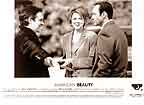
Sam Mendes with Annette Benning and Kevin Spacey
|
 |
American Beauty takes potshots at gays and the middle class
By
Michael Bronski
American Beauty
Sam Mendes, director; with Kevin Spacey, Annette Bening, Thora Birch, Mena Suvari, Peter Gallagher, Wes Bentley, Chris Cooper
How to order
There is a vulgar notion in American art that by simply attacking the middle class and its values, a novel, play, or film attains major importance. Thus the problem
with Sam Mendes's film American
Beauty.
American Beauty is the newest of a spate of recent critiques of American values about work, family, life, and sex:
The Ice Storm, Welcome to the Doll House,
The Opposite of Sex, The Truman Show, Pleasantville,
Happiness, and Election. All these films-- to varying degrees successful-- dissected life, happiness, and the
American Way. Here, Lester Burnham (Kevin Spacey) is a discontent suburbanite who hates, his life, job, and family. Wife Carolyn (Annette Bening), is
hyper-perfectionist, superficial, and obsessed with her always-failing career in real estate. His daughter Jane (Thora Birch) is aimlessly angry and discontent. Lester becomes obsessed
with his daughter's best friend, sex-obsessed Angela (Mena Suvari); Carolyn becomes obsessed with Buddy Kane (Peter Gallagher), a successful real-estate salesman;
and Ricky (Wes Bentley), a teenaged drug-dealing, video-stalking next-door neighbor, becomes obsessed with Jane. And by the end of the film-- in a shocking
and completely unbelievable revelation-- Ricky's right-wing, violent Marine-colonel father Colonel Fitts (Chris Cooper) becomes obsessed with the idea that his son
is having an affair with Lester, and finally with Lester himself.
As written by Alan Ball, American
Beauty initially has the feel of broad satire, as Carolyn explains that it is egg shells that make her American Beauty roses
so flawless. But soon it becomes clear that the film wants to be taken as biting social critique. When Lester begins his revolt-- he quits his meaningless job, refuses to
eat Carolyn's perfect dinners, and begins to move from fantasy to overtly flirting with Angela and
getting stoned with Ricky-- we are supposed to cheer. And why not? It's
more fun and freeing than what anyone else is doing.
But everything here is sophomoric in execution. This is the sort of film that offers a 20-second shot of bacon sizzling in a pan to tell us how hollow these
people's lives are, or shows us one of Ricky's videos-- an empty plastic bag drifting in the wind-- as if offering a philosophy of life. When you think about what David Lynch
did brilliantly in Blue Velvet-- a film Mendes repeatedly draws upon for imagery and visual tone-- you appreciate how banal and labored is
American Beauty.
But perhaps most problematic is American
Beauty's reliance on its gay characters to expose the corrupt undercurrents of middle-class life. Carolyn runs into a
pair of mean-spirited dykes while selling a house, and the Bernhams have a brace of gay neighbors who are prototypical boring suburban queens. Both couples are
handled as comic relief, which is not the worst thing in this world of shallow people with superficial lives.
But by the end of the film, as the hetero protagonists struggle-- valiantly, in the filmmakers' eyes-- to find some moral or meaning in life, they are juxtaposed
with Colonel Fitts, the only character whose search for meaning leads to violence and bloody murder. We are given few cues into Colonel Fitts's character. He is a
brutal husband and father, beating his son Ricky for the least perceived misbehavior. Fitts is violently homophobic toward the neighborhood's gay couple and acts
insanely violent when he thinks Ricky is giving blow jobs for money to next-door neighbor Lester. This man is so bad that he even collects Nazi memorabilia. Nothing butch
like pistols or a hand grenades-- he collects plates from Hitler's dinner parties. Talk about perverted: a Nazi plate queen! It's little surprise then when Colonel Fitts turns
out to be a repressed homosexual who comes onto Lester and when politely rejected gets a revolver and shoots the nice man in the head. (This sort of casual,
causal connection between Nazism and homosexuality was also the basis for
Apt Pupil last year.)
What is troubling here is not that Colonel Fitts is a homosexual-- there should be more films with gay characters that act in all kinds of ways-- but that, unlike
the other people in this drama, he is defined only through his sexuality. Even his attempt to break out of his emotional cage results in killing Lester, who is the moral center of
the film.
American Beauty has been such a critical hit partly because it allows audiences to feel superior to all of its characters. "I can
see myself in these people," they may think, "but I am not that bad." But the one person with whom they do not have to identify-- the
really bad character-- is Colonel Fitts, who, even in a damaged and debased world, is beyond redemption. Without the bad homo lurking in the
corrupt moral center of the film, American
Beauty would lack the punch that brings its shallow view of American life to a disconcerting climax.
| Author Profile: Michael Bronski |

|
Michael Bronski is the author of
Culture Clash: The Making of Gay
Sensibility and The Pleasure
Principle: Sex, Backlash, and the
Struggle for Gay Freedom. He writes
frequently on sex, books, movies, and
culture, and lives in Cambridge,
Massachusetts. |
| Email: |
mabronski@aol.com |
You are not logged in.
No comments yet, but
click here to be the first to comment on this
Movie Review!
|